Vermont Bird Friendly Maple Sugarbush

Collaborating to keep sugarbush habitat sweet for songbirds

While maple syrup can look and taste the same, it can come from forests that are managed in dramatically different ways. Park-like maple monocultures may appeal to our tidy aesthetic and increase sap production over the short-term, but they support relatively low numbers of birds and bird species. In contrast, biologically and structurally diverse sugarbushes offer great places for birds to forage, find cover, and raise their young. They are also likely to have better long-term sap production, fewer forest health problems, and be better able to adapt to the stresses of climate change.

The Bird-Friendly Maple Project is ready to give you and maple-lovers everywhere a way to support and promote sugarbush management that’s good for Vermont’s birds, forests, and forest-based economy. The project is building on the national award-winning Foresters for the Birds partnership between Audubon Vermont biologists and Vermont Department of Forests, Parks & Recreation foresters and expanding to include a new partner: leaders from the Vermont maple industry that includes the Vermont Maple Sugar Makers Association.

By keeping forests intact, maple sugarbushes are pretty good
places for birds to nest and find food. But with a little extra
consideration, their long-term value to birds and overall forest
health can increase.
A bird-friendly sugarbush is managed for these features to
offer great places for birds to forage, hide, and raise their
young:
■ A diversity of tree species; more than just maple
■ Layers of vegetation; from small seedlings on the forest
floor, to saplings and shrubs, to the canopy overhead
■ Standing dead trees and live trees with cavities; the bigger
the better
■ Logs and branches on the forest floor
■ Birds singing!

The Bird-Friendly Maple Project is a collaborative effort to
integrate bird conservation with Vermont’s maple syrup
industry by:
■ Promoting sugarbush management practices that support
birds, forest health, and sustainable sap production
■ Recognizing maple producers for considering bird habitat
in their sugarbush
■ Increasing awareness of the important role Vermont’s
forests play in bird conservation
■ Educating consumers about maple syrup and its many
natural benefits
Whether you’re a bird watcher, maple producer, or simply
enjoy the taste of pure maple syrup, the Bird-Friendly Maple
Project is for you!

Each year, as winter slowly transitions to spring, the sweet
sap of maple trees is collected from the forest and boiled
down to create a signature Vermont product—pure maple
syrup.
A few short weeks later, the same forests that were buzzing
with maple sugaring activity, referred to as sugarbushes,
come alive with the songs and bright colors of songbirds.
These birds, many of which spend the winter in the tropics,
will look to find an abundance of insects to feed on, cover
from predators, and places to conceal a nest—all in an effort
to successfully raise the next generation of their species.
Add to this the fact that Vermont forests are a globally
important nesting habitat for many of these species, and the
bird conservation value of sugarbushes just got a little bit
sweeter!


http://vt.audubon.org/conservation/working-lands/landing/bird-friendly-maple-project
Cold Hollow to Canada

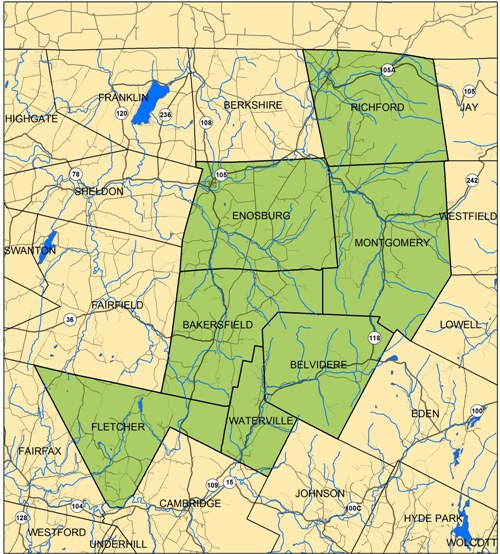
THE COLD HOLLOW TO CANADA VISION Our vision is a healthy and intact forested landscape that supports a strong and sustainable local economy through stewardship, with permanent protection of core wildlife habitat and connectivity across the entire Northern Forest. We can achieve this vision when there is: Ongoing stewardship of our regions forests built on…

Woodlots and Birds

We are a certified Bird Friendly Sugarbush with the Vermont Audubon Society. Our next project is a woodlot in the lower part of our property. We don’t tap this area because its heavily concentrated with softwoods. Most of it used to be pasture for cows when I was growing up. I would like to convert part of the area into agriculture – an apple orchard and possibly berries. Some of it may convert back to pasture as well.
I have taken 5 acres and will be working on a “patch cut” this year. A patch cut is to increase the habitat for native bird species and migratory birds as well as mammals. We will be removing 90% of the trees that are on this 5 acre piece. I am selectively choosing the trees that I want to keep – no most of them are NOT maple in this case! I have chosen several apple trees, a nice stand of white birch and another stand of old spruce. I’ve randomly picked a few younger trees – a cherry or two, but sometimes I’ve picked some huge gnarly old mishaped trees just because they spoke to me. I like trees with character.
In addition to those I also will leave some of the trees that are already dead and fallen and several trees that are either already dead or mostly dead but still standing – bugs love these trees which in turn means birds love them. Most of the trees that are cut will be used to heat my house next year. The branches and leftovers will be thrown in piles to create natural hiding and nesting places for the birds and creatures like bunny rabbits.
The point of cutting such a high percentage of trees is to encourage the undergrowth to flourish – this will be grasses that create seeds and berries to grow to feed the birds. Overall the hope is the patch cut will see an increase in the number and variety of birds in the area.
The woodlots program that created this patch cut idea also ties back into the Cold Hollow to Canada program that wants to create wildlife corridors. We are a tiny piece of the largest temperate forest in the world and are trying to help do our small piece to this big puzzle.
#birdfriendlymaple #coldhollowtocanada #audubon

The Mole Family

There are many great story tellers in the family – I am not one of them.  I can remember about 3 jokes – this is one of them and the last one shared with Grampa Hue – the master storyteller. April was here and signs of spring were finally showing.  The mole family was just…

Hurry Up and Wait

Well Uncle Sam has nothing on Mother Nature and they both have taught me patience with the Hurry Up and Wait routine.  We hurried and tapped in January only to wait for the first run, now we’re waiting again for the freeze to let up. We haven’t boiled in about 2 weeks. Tomorrow into next week is finally looking good again.   Ideally we want temps to drop below freezing at night then warm during the day – but not too warm so the sap stays cold.  We also don’t want it to stay warm too many days in a row without freezing because the tree will start sending its energy – the sap- into it’s branches to begin making leaves and buds.  This happens at the end of the season and the syrup takes on a “buddy taste”  and we stop sugaring for the year.

Sap yield per tree ranges from 10 – 20 gallons of sap per tree – depending on age, condtion and season.  It takes 40 gallons of sap to make 1 gallon of syrup (sugar content does factor in here).  So it can take 2-4 trees to make 1 gallon of maple syrup.  The sugar concentration of sap runs about 2% +/- we then run the raw sap through our Reverse Osmosis to increase the concentration to 12-16% sugar.  This “sweet” is then boiled until it reaches a Brix measurement of 66.9*which is a density measurement to make sure the syrup has the right consistency or viscosity ( the ability of a liquid being able to flow).  This gives the syrup the right texture and flavor concentration.

My father says “Sap is like Holy Water – you gotta boil the Hell out of it”