
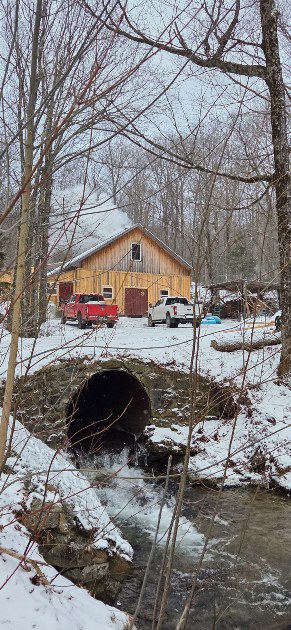
The sweetest season is here! The sap was flowing. Then it stopped for a week. Now it’s back! Next week looks like it should be a steady flow of sap with temps rising each day and falling at night.
I was fortunate this year that I was able to hire a custom crew to come in and finish tapping. I’ve been on their wait list for a couple of years and finally made the cut. The snow was deep, the temps were cold. Julie managed to come help a couple of days, but the rest was up to me. Did I mention how grateful I was I could hire a crew?
This year we upgraded our 20+ year old mechanical sap releaser with an electric version. This version has separate chambers that open and shut to pull sap without effecting the vacuum that’s being pulled on the lines. That was the last major piece of equipment to upgrade in the sugarhouse. It was so nice to be able to start up the equipment this year and just have everything work.
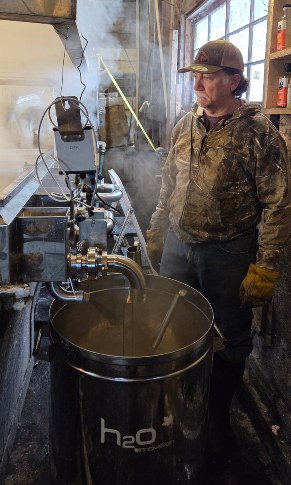
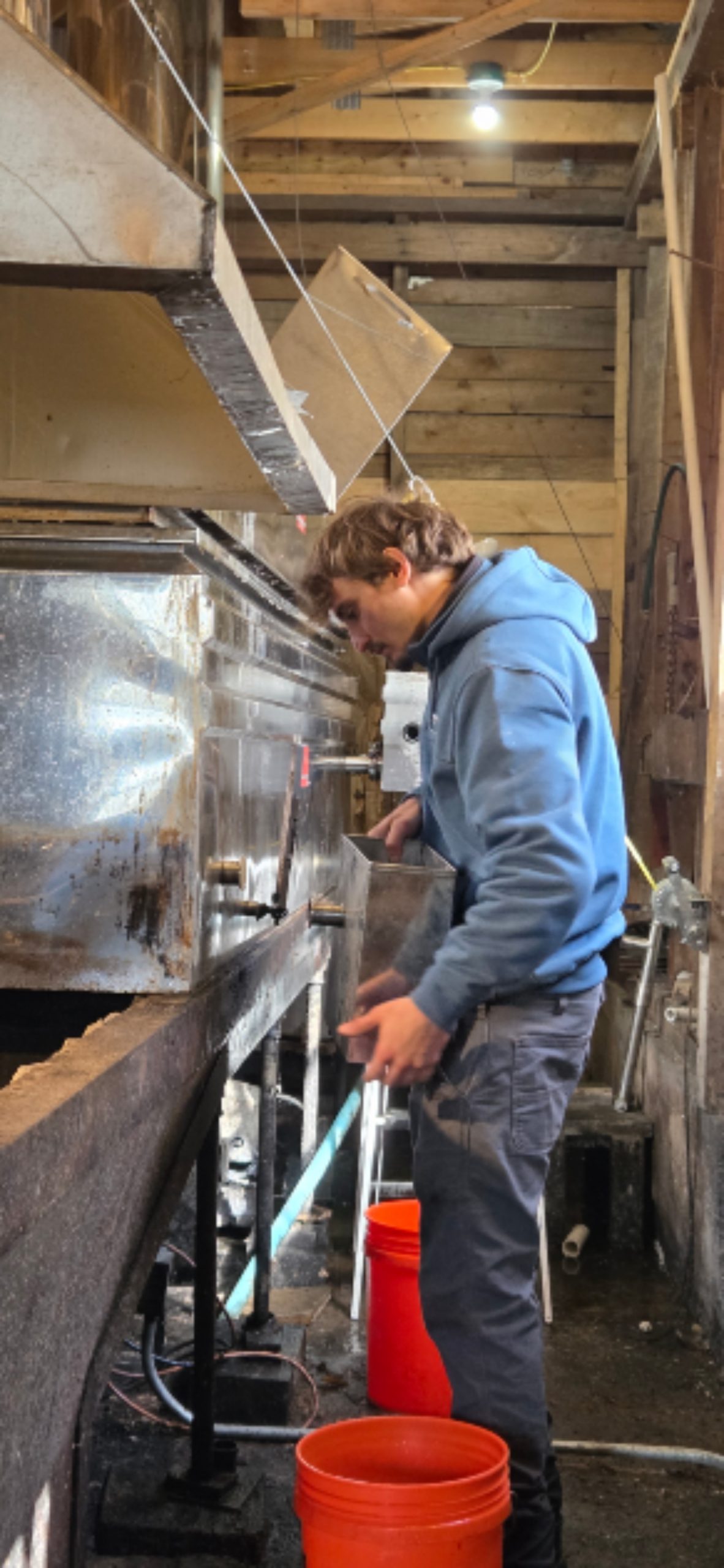
Ian connecting the pans to boil sap
What’s the process?
Raw sap comes directly from maple trees at about 2.5 % sweet water. The tubing lines connect to the releaser in the sugarhouse. The releaser pumps the raw sap into holding tanks. Next the sap is run through the reverse osmosis. The R.O. brings the sap to 18% sweet and is pumped to another holding tank. From this tank, the sap is piped to the boiling pans. We use wood to heat the arch. The arch is collectively the entire set up of firebox, metal frame holding the pans and the pans themselves. The pans have a series of channels and float valves, water is evaporated from the sap. The closer to the front of the pans, the greater the sugar content. We measure sugar content with a Brix scale. At “draw off” when the syrup leaves the pan it needs to be a minimum of 67 %.
Syrup is drawn off the pan, run through a high pressure filter press and stored in 40 gallon stainless steel barrels. We are selling about 2/3 of our crop wholesale to Butternut Mountain Farm. We retail the rest. When we are ready to can or jug the syrup, we open a barrel, heat the syrup to 180* and hot pack it. We can the entire 40 gallons at a time in a variety of plastic and glass containers.